Common Measurement Conversions Everyone Should Know
If you cook, travel, or track fitness, you already rely on measurement conversions more than you think. You may know a few basics, but the useful ones go further: inches to feet, pounds to kilograms, Fahrenheit to Celsius, and miles to kilometers. Once you understand the patterns, you can avoid costly mistakes and move faster with everyday tasks. The real question is which conversions matter most for your routine.
Key Takeaways
- Know core conversions like inches to feet, pounds to kilograms, miles to kilometers, and Fahrenheit to Celsius.
- Accurate measurement prevents mistakes in projects, cooking, travel, and fitness.
- Use conversion charts or online calculators for quick, reliable unit checks.
- Remember metric and imperial conversions, especially inches to centimeters and pounds to kilograms.
- Practice with everyday examples and mnemonic aids to build confidence and recall.
The Most Useful Measurement Conversions
When you work with measurement conversions, the most useful ones are the ones you’ll use repeatedly in everyday tasks, such as converting inches to feet, pounds to kilograms, miles to kilometers, and Fahrenheit to Celsius.
You can rely on useful tools like conversion charts, online calculators, and educational resources to check answers quickly. For practical applications, keep a quick reference nearby so you can handle cooking, travel, fitness, and home projects without hesitation.
Everyday examples help you spot patterns and build confidence. You’ll also avoid common mistakes by matching units before you calculate and by verifying whether the result needs rounding.
Everyday examples help you spot patterns, build confidence, and avoid common conversion mistakes.
When you practice with your group, you strengthen accuracy and belong to a community that values clear, consistent measurement.
Metric and Imperial Conversions
Metric and imperial conversions matter most when you need to translate between the two systems without losing accuracy. You can rely on Metric Systems for decimal simplicity and Imperial Systems for familiar everyday scales, but you should always match units carefully.
Use Conversion Tools to check factors such as inches to centimeters or pounds to kilograms, and verify results against trusted Measurement Standards. Historical Conversions explain why both systems still coexist, while Scientific Applications demand exactness and repeatability.
For Practical Uses, you’ll often convert distances, weights, and volumes to communicate clearly with others. In Everyday Applications, these skills help you fit in across regions, follow instructions, and avoid errors.
When you know the core ratios, you’ll move confidently between systems and stay aligned with your group.
Common Kitchen Measurement Conversions
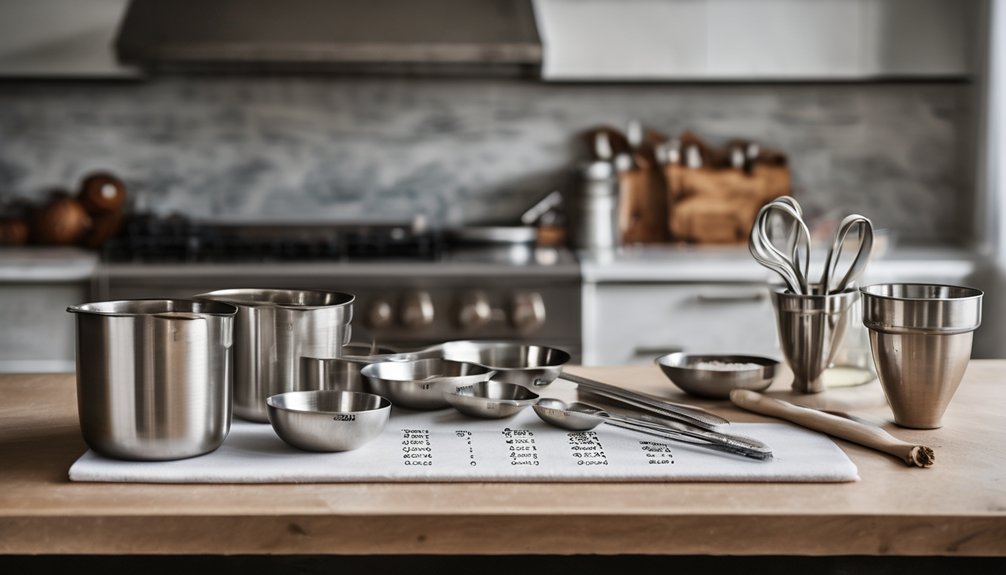
Kitchen measurements follow the same logic as other unit conversions, but the stakes are often more immediate because small errors can change a recipe’s outcome. You can rely on kitchen tools like cups, spoons, and scales to compare ingredient equivalents accurately.
Use consistent measuring techniques: level dry ingredients, read liquids at eye level, and pack only when a recipe says so. These cooking tips help you avoid common mistakes that distort volume ratios and throw off precision baking.
When you’re making recipe adjustments, remember that portion sizes and scaling recipes aren’t just arithmetic; they affect texture, moisture, and flavor. In a kitchen community, accurate conversions help you cook with confidence, share dependable results, and trust that your dish will match the standard you’re aiming for.
Length Conversions You’ll Use Often
Length conversions matter anywhere you compare distances, dimensions, or heights, because even a small unit mismatch can distort a measurement. You can stay accurate by learning metric prefixes and checking quick references before you estimate.
For practical applications, use these four steps:
- Match the unit you have to the unit you need.
- Use conversion tools or online calculators when the numbers get tricky.
- Verify results with measurement charts and visual aids.
- Test the answer with everyday examples, like door widths or room lengths.
When you work this way, you join a group of people who measure confidently and avoid avoidable errors.
Keep a small set of conversion tools nearby, and you’ll handle length changes fast, logically, and with less second-guessing.
Weight and Mass Conversions Made Simple
When you switch between weight and mass units, you need to know whether you’re converting within the same system or across systems, because grams, kilograms, ounces, and pounds don’t always scale the same way.
You can read mass units using metric prefixes, then check weight scales for pounds or ounces. In science context, you’ll often use grams and kilograms; in everyday work, historical units still appear on packaging and labels.
Use conversion charts or conversion tools to move confidently between systems. For practical applications, you can compare real life examples, like groceries, luggage, or recipes, and spot when density factors matter instead of simple multiplication.
Use conversion charts or tools to move confidently between systems, and watch for density when simple multiplication won’t do.
When you understand the pattern, you’ll fit in with anyone handling measurements, and you’ll convert quickly and accurately.
Liquid and Dry Volume Conversions
Liquid volume and dry volume each use their own measuring tools, so you need to match the unit to the substance before converting. You’ll stay aligned with volume standards when you separate liquid measurements from dry measurements. Use conversion charts to check unit equivalencies fast and avoid guesswork in shared kitchens.
- Measure liquids with clear cups, spoons, or marked jugs.
- Level dry ingredients with flat edges, not by shaking.
- Apply recipe adjustments only after you confirm the original unit.
- Match cooking techniques to the ingredient’s density and form.
When you convert accurately, you protect texture, flavor, and consistency. You also join the group of cooks who rely on measurement tools instead of habit. That precision makes your results repeatable and dependable.
Temperature Conversions for Cooking and Weather
Temperature conversions help you interpret recipes and forecasts correctly because different systems use different scales for the same thermal reading.
When you read Fahrenheit Celsius values, you can quickly match a recipe’s oven setting to your kitchen or judge a forecast from another region.
For Cooking Weather decisions, convert 350°F to about 177°C, and 0°C to 32°F, so you know when water freezes or when baked goods should rise steadily.
You’ll make fewer mistakes when you memorize a few anchor points and estimate from them. That habit helps you feel prepared, whether you’re adjusting sauce heat or planning for a chilly morning.
With practice, you join others who handle measurements confidently and accurately.
Distance Conversions for Travel and Fitness
Just as temperature scales help you compare recipes and forecasts, distance units let you compare routes, workouts, and maps with confidence. You can convert miles to kilometers, or feet to meters, to make travel distances clearer and support route planning.
For fitness milestones, use simple ratios to check distance running, cycling metrics, hiking trails, and walking distances.
- Convert before you leave so journey durations stay realistic.
- Match units to your device for pace calculations.
- Use the same unit across apps to improve travel efficiency.
- Recheck numbers when terrain or elevation changes.
When you measure consistently, you join a community that values accuracy and progress. Those shared standards help you track effort, compare results, and move forward with confidence.
Area Conversions for Everyday Use
When you compare spaces across plans, you often need to convert area units so you can judge size accurately. You’ll use square footage to compare rooms, estimate home renovations, and verify flooring calculations before you buy materials.
In land measurements, you may move between square feet, acres, and square meters to understand property assessments or real estate conversions without confusion. For garden planning, area conversions help you size beds, paths, and irrigation zones with confidence.
You can also evaluate outdoor spaces by checking whether a patio or yard meets your needs. When you read listings or diagrams, you belong to the group that checks numbers carefully, and that habit gives you clearer decisions, fewer surprises, and better control over each project.
Simple Ways to Memorize Common Conversions
Memory anchors make common conversions easier to retain. You can build a shared skill set by using visual aids and mnemonic devices that link numbers to familiar patterns. Keep flash cards nearby, and review them in short, focused sessions. Use conversion charts to compare units directly, then test yourself with practical examples from everyday applications.
- Pair each conversion with a picture.
- Repeat it aloud in a steady rhythm.
- Practice with digital tools and interactive quizzes.
- Check your recall under time pressure.
When you rehearse consistently, you’ll notice faster retrieval and fewer errors. You’re not memorizing alone; you’re joining a practical approach that helps your group think clearly, solve problems faster, and use measurements with confidence.
Frequently Asked Questions
How Do I Convert Pressure Units Like Psi to Pascals?
Multiply psi by 6,894.76 to get pascals. You’re handling pressure measurement clearly, so use that factor for unit applications. If you’ve got 10 psi, you’ll convert it to 68,947.6 Pa.
What’s the Conversion Between Horsepower and Watts?
1 horsepower equals 745.7 watts, so you can multiply horsepower by 745.7 to get watts. You’ll compare power measurement precisely, and horsepower efficiency calculations will help you fit in with engineering teams.
How Do I Change Data Storage From Megabytes to Gigabytes?
Easy as pie: divide the data storage file size in megabytes by 1,024 to get gigabytes. You’ll see the number shrink, and you’ll fit better with others comparing files confidently.
What Is the Conversion From Joules to Calories?
You convert joules to calories by dividing by 4.184; 1 calorie equals 4.184 joules. You can compare energy units this way, and your calorie usage calculations’ll stay accurate and easy within your group.
How Do I Convert Speed From Knots to Kilometers per Hour?
Multiply knots by 1.852 to get kilometers per hour, like wind turning a sail. You’re using the knots definition: nautical miles per hour. This conversion helps you judge speed implications clearly, confidently, and together.
Conclusion
In the end, knowing common measurement conversions helps you move through daily tasks with confidence. You can switch between metric and imperial units, adjust recipes, track workouts, and plan travel without hesitation. Once you learn a few core values, the rest falls into place like a neat row of dominoes. Use charts, apps, or memory tricks to stay accurate, and you’ll save time, avoid errors, and make every measurement count.