Cooking Measurement Converter
Nearly 60% of home cooks say measurement errors ruin a recipe at least once a month. You can avoid that by using a cooking measurement converter to move quickly between cups, tablespoons, grams, ounces, milliliters, and liters. It helps you scale recipes, keep ratios intact, and prevent costly mistakes. Once you know the basic conversions, your results get more consistent, but a few common traps can still throw everything off.
Key Takeaways
- Use standard kitchen conversions: 1 tablespoon equals 3 teaspoons, 1 cup equals 16 tablespoons, and 1 pint equals 2 cups.
- Convert cups and teaspoons accurately: 1 cup equals 48 teaspoons, so divide teaspoons by 48 to find cup equivalents.
- For weight, remember 1 ounce is about 28 grams, and divide grams by 28 to convert to ounces.
- For volume, 1 liter equals 1,000 milliliters, so multiply liters by 1,000 or divide milliliters by 1,000.
- Measure carefully by leveling dry ingredients, checking liquids at eye level, and converting before mixing.
Convert Common Cooking Measurements Fast
When you need a quick cooking conversion, start with the basics: 1 tablespoon equals 3 teaspoons, 1 cup equals 16 tablespoons, and 1 pint equals 2 cups.
You can move fast when you keep these ratios in mind and use kitchen tools marked clearly. Measure level ingredients, not heaped ones, so your measurement accuracy stays strong and your results stay dependable.
If a recipe feels unfamiliar, pause and convert before you mix. That small habit helps you fit right in with confident cooks who trust the numbers.
Keep a spoon, a measuring cup, and a simple chart close by, and you’ll save time without guessing. Clear conversions make everyday cooking smoother, calmer, and more consistent for you.
Convert Cups, Tablespoons, and Teaspoons
Cups, tablespoons, and teaspoons are easiest to convert when you anchor everything to a few fixed relationships: 1 cup equals 16 tablespoons, 1 tablespoon equals 3 teaspoons, and 1 cup equals 48 teaspoons.
When you need cup equivalents, divide teaspoons by 48 or tablespoons by 16. If a recipe calls for 2/3 cup, you can read that as 10 tablespoons plus 2 teaspoons.
For tablespoon variations, multiply by 3 to move into teaspoons, or divide teaspoons by 3 to return to tablespoons.
Keep these anchors in mind, and you’ll move through recipes with your crew’s confidence intact. You don’t need guesswork; you just need the same conversion map every time.
Use it, and your measurements stay consistent, quick, and reliable.
Convert Grams and Ounces
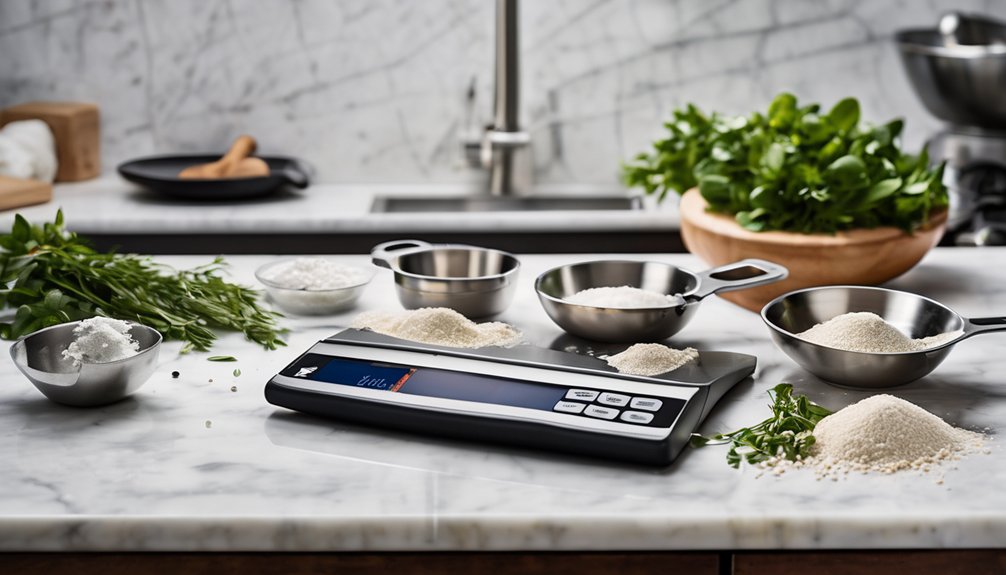
Once you’ve got cups, tablespoons, and teaspoons mapped out, grams and ounces are the next units to lock down, especially when you’re weighing ingredients instead of scooping them.
You can treat 1 ounce as about 28 grams, and 1 gram as about 0.035 ounces. For quick gram equivalents, multiply ounces by 28; for ounce conversions, divide grams by 28. That gets you close enough for everyday cooking, baking, and meal prep.
When a recipe asks for 4 ounces, you’ll know you need roughly 113 grams. If it calls for 50 grams, you’re looking at about 1.8 ounces.
Keep a scale handy, trust the numbers, and you’ll fit right in with cooks who measure confidently and consistently.
Convert Milliliters and Liters
Milliliters and liters are easy to convert once you remember that 1 liter equals 1,000 milliliters. You’re handling liquid volume with a simple decimal shift, so your milliliters liters math stays quick and reliable. Use this guide:
| Liters | Milliliters | Use |
|---|---|---|
| 0.25 | 250 | Small pour |
| 0.5 | 500 | Half liter |
| 1 | 1,000 | Full liter |
| 1.5 | 1,500 | Large batch |
To convert liters to milliliters, multiply by 1,000. To convert milliliters to liters, divide by 1,000. You’ll fit right in when you measure drinks, soups, or sauces with confidence. Keep the decimal in the right place, and you’ll avoid guesswork. When a recipe asks for either unit, you can switch fast and keep cooking smoothly.
Scale Recipes Without Ruining Ratios
When you scale a recipe, keep the ratios intact so each ingredient still does its job. You can trust recipe scaling when you multiply every amount by the same factor. If you double the batch, double the flour, liquid, fat, salt, and spices together.
That keeps ingredient ratios balanced, so texture and flavor stay familiar and your dish feels like it belongs at your table. For smaller batches, divide each measure by the same number, then check that the result still makes sense in practice.
Use a converter or calculator when decimals get messy, but keep the method consistent. When you stay disciplined, you protect the recipe’s structure and cook with confidence, whether you’re feeding two people or a full crowd.
Avoid Common Measurement Mistakes
Even with perfect scaling, small measurement errors can throw off a recipe fast, so measure carefully from the start. You’ll avoid common measurement pitfalls by reading units before you pour, leveling dry ingredients, and checking whether your converter uses weight or volume.
Don’t guess with sticky foods like honey or peanut butter; lightly oil the spoon or cup so you don’t leave half behind. For liquids, set the cup on a flat surface and check at eye level to keep the meniscus honest.
For dry goods, spoon and sweep instead of scooping straight from the bag. Precision importance grows when you cook for others, because a shared meal deserves reliable results and the confidence that you belong in the kitchen.
Use a Cooking Measurement Converter Confidently
A good cooking measurement converter helps you move between cups, tablespoons, grams, and milliliters without second-guessing yourself. Keep it close to your favorite kitchen tools so you can check values while you cook.
When you convert, match the ingredient type first, since flour, sugar, and liquids don’t weigh the same by volume. Trust measurement accuracy by using level scoops, clean spoons, and a calibrated scale when needed.
If you’re following recipes from different regions, a converter helps you stay in sync with the cooking community and makes shared dishes turn out right.
Save common conversions for ingredients you use often, and you’ll work faster, waste less, and feel more confident every time you step into the kitchen.
Conclusion
So, you’ve met the noble cooking measurement converter: the tiny hero that saves dinner from your “close enough” philosophy. Use it, and you’ll swap cups for grams without drama, scale recipes without turning soup into cement, and avoid the ancient ritual of guessing. Trust the numbers, not your heroic instincts. With a quick check, you’ll cook smarter, waste less, and maybe even stop pretending tablespoons are a personality trait.