Volume Converter
Like a quiet compass in a crowded kitchen or lab, a volume converter helps you translate measurements with exactness. You can move between liters, milliliters, gallons, quarts, and smaller units without relying on memory or rough estimates. The formulas are fixed, but the mistakes aren’t, and one missed conversion can skew results. Knowing which units belong together matters more than you might think, especially when precision starts to decide the outcome.
Key Takeaways
- A volume converter quickly converts between units like liters, milliliters, gallons, quarts, pints, cups, and tablespoons.
- Use fixed ratios, such as 1 liter = 1,000 milliliters and 1 gallon = 4 quarts, for accurate conversions.
- Volume converters are helpful in cooking, lab work, engineering, and shipping where precise measurements matter.
- Avoid common errors like mixing metric and imperial units, rounding too early, or skipping verification checks.
- Checking conversions at least twice improves accuracy and builds trust in the final result.
What Is a Volume Converter?
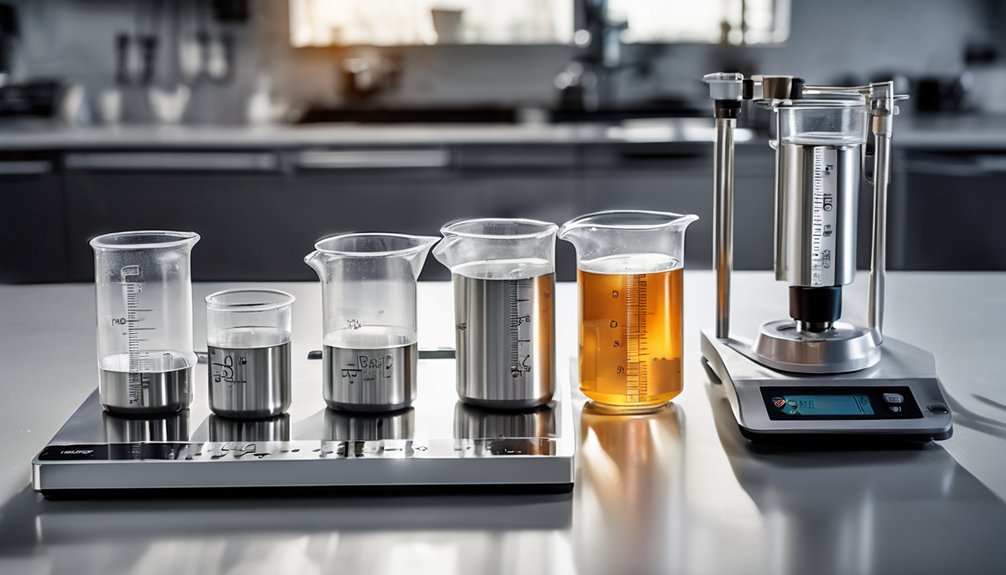
You use it when you need quick, accurate metric conversions across different systems. It helps you compare fluid measurements without manual lookup tables or guesswork.
In practice, you enter a known volume, select the source unit, choose the target unit, and get an equivalent value immediately. This keeps your calculations consistent, especially when you work with recipes, engineering data, or shipping specifications.
If you often handle diverse units, a converter gives you a reliable, shared reference point, so you can stay confident and aligned with your team.
How Volume Conversion Formulas Work
Volume conversion formulas work by expressing every unit as a fixed ratio to a common reference, then scaling values through that reference.
You convert by multiplying when you move to smaller units and dividing when you move to larger ones. This approach keeps unit relationships consistent, so you can trust each step in the chain.
For example, if you know one reference value, you can derive others without guessing or memorizing separate rules. You belong to a system built on measurable links, not shortcuts.
That structure improves conversion accuracy because each formula preserves proportionality across the full range of values. When you apply the ratio correctly, your result stays precise, reproducible, and easy to verify.
Volume Converter for Liters and Milliliters
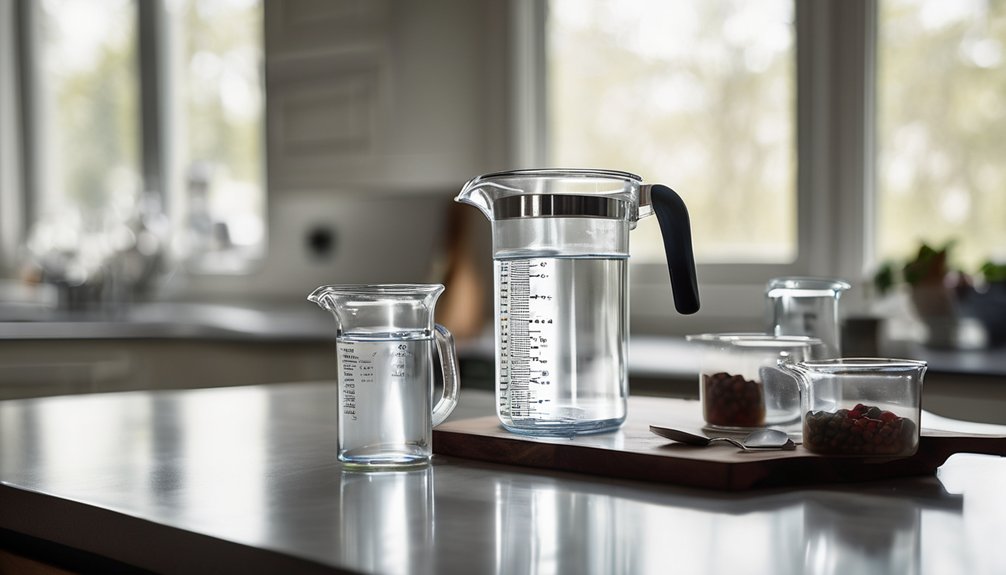
Once you understand ratios, converting between liters and milliliters becomes straightforward because both units sit on the same metric scale. You can trust a simple factor: 1 liter equals 1,000 milliliters. That means you multiply liters by 1,000 for milliliters conversion, or divide milliliters by 1,000 to return to liters. This keeps your measurements consistent in labs, kitchens, and packaging workflows, where precise liters usage matters.
- Check the unit first, so you know the direction of conversion.
- Apply the 1:1,000 ratio without rounding until the final step.
- Verify the result against expected scale to catch errors quickly.
When you use this method, you join a disciplined approach that makes volume data reliable, readable, and easy to compare across tasks.
Volume Converter for Gallons, Quarts, and Pints
When you convert gallons, quarts, and pints, you need to track the scale carefully because each unit fits into a fixed customary system: 1 gallon equals 4 quarts, and 1 quart equals 2 pints.
You can use this structure to verify gallon measurements and apply quart definitions without guesswork. In practical liquid conversions, you move stepwise so measurement accuracy stays high and your results support cooking ratios for shared recipes.
You’ll also notice that pint uses often link to serving sizes, while larger volume applications demand consistent totals across containers.
If you need finer checking, compare against a fluid ounce reference, but keep the main customary hierarchy intact.
With this method, you stay aligned with your team, reduce error, and convert confidently every time.
Volume Converter for Cups and Tablespoons
For cups and tablespoons, you can convert accurately by using the fixed customary ratio: 1 cup equals 16 tablespoons.
When you work with cup measurements, divide cups by 1/16 to get tablespoon equivalents, or multiply cups by 16 to stay exact. This approach keeps your calculations consistent, whether you’re scaling a recipe or checking a serving size.
- 1/4 cup = 4 tablespoons
- 1/2 cup = 8 tablespoons
- 3/4 cup = 12 tablespoons
You belong in a process that values precision, so use the ratio every time and avoid estimating.
If you need smaller increments, convert the cup first, then split the tablespoons into fractions. That method gives you clean, reliable results without confusion.
Cubic Meters vs. Cubic Centimeters
Cubic meters and cubic centimeters measure the same volume at different scales, and you can convert between them with a fixed metric relationship: 1 cubic meter equals 1,000,000 cubic centimeters. When you work in cubic meters, you handle larger spaces; when you use cubic centimeters, you capture smaller, more detailed volumes. You belong to the same metric system, so the math stays consistent.
| Unit | Symbol | Scale |
|---|---|---|
| Cubic meter | m³ | Large |
| Cubic centimeter | cm³ | Small |
To convert, multiply cubic meters by 1,000,000 to get cubic centimeters, or divide cubic centimeters by 1,000,000 to get cubic meters. This precise ratio helps you compare measurements confidently and avoid scale errors.
Quick Volume Conversion Chart for Common Units
A quick-reference chart lets you convert common volume units without re-deriving each relationship. You can use it to move between liters, milliliters, cubic meters, and cubic centimeters with confidence. This shared tool helps you compare values across practical applications and check historical measurements used in older records.
- 1 m³ = 1,000 L = 1,000,000 mL
- 1 L = 1,000 mL = 1,000 cm³
- 1 cm³ = 1 mL, a precise equivalence
When you memorize these anchors, you reduce error and speed up verification. You’ll fit in with teams that value numerical consistency, because your conversions stay traceable and repeatable.
Use the chart as a disciplined reference, not a guess, and you’ll communicate volume clearly across systems and contexts.
Volume Converter for Cooking
Cooking often needs the same conversion discipline you’d use for any volume calculation, but with measurements that show up as cups, tablespoons, teaspoons, milliliters, and liters. You can convert cooking measurements by matching each unit to a fixed ratio, then scaling ingredients with confidence.
For example, 1 cup equals 16 tablespoons, and 1 tablespoon equals 3 teaspoons, so you can move between recipes without guessing. When you handle ingredient conversions, you reduce error, protect texture, and keep seasoning balanced.
If you’re cooking with a shared pantry or adapting family recipes, this precision helps you stay in sync with the group. A reliable volume converter gives you consistency, especially when you halve, double, or standardize portions across your kitchen workflow.
Volume Converter for Science and Lab Work
In science and lab work, you use a volume converter to translate between milliliters, liters, microliters, cubic centimeters, and other units with exact proportional relationships. You protect volume measurement by keeping each value traceable to a standard unit, so your data stays comparable across protocols.
- Convert reagent volumes before preparing buffers, media, or standards.
- Verify instrument readouts when you transfer liquid between calibrated vessels.
- Record converted values in your notebook to support scientific accuracy and team consistency.
When you work this way, you join a precise workflow that values repeatable results and shared lab practice. A reliable converter helps you communicate measurements clearly, reduce ambiguity, and maintain control over every dilution, aliquot, and sample preparation step.
Common Volume Conversion Mistakes
Even a small volume conversion error can cascade through a recipe, lab protocol, or shipping calculation, so you need to check unit labels, decimal placement, and metric-to-imperial assumptions before you convert. You’ll avoid common errors by matching the source unit exactly and confirming the target scale.
| Mistake | Impact |
|---|---|
| Unit confusion | Wrong magnitude |
| Decimal shift | Tenfold error |
| Mixing systems | Invalid result |
| Rounding too early | Lost precision |
| Skipping checks | Hidden mismatch |
When you work with mL, L, oz, or gal, read the notation twice and verify the factor. If you’re part of a team, standardize formats so everyone stays aligned. That shared discipline reduces rework, protects accuracy, and helps you trust each conversion.
Conclusion
You’ve seen how a volume converter turns complexity into clarity, and that precision matters every time you measure. Whether you’re scaling a recipe, verifying a lab sample, or comparing unit systems, you can trust consistent formulas to guide you. Don’t let small errors compound into big problems; instead, convert with confidence and accuracy. In measurement, every drop counts, every unit matters, and every conversion helps you move from guesswork to certainty.